TL;DR: Social proof is the psychological principle that makes people follow the crowd — and it’s the invisible force behind almost every purchasing decision and follow button click on social media. Brands that understand and strategically build social proof grow faster, convert better, and command higher trust. Here’s how to leverage all six types of social proof to accelerate your growth.
In 1984, psychologist Robert Cialdini published Influence: The Psychology of Persuasion and introduced the world to six principles of persuasion. One of them — social proof — has become arguably the most powerful force in digital marketing. Four decades later, its influence has only intensified.
Every time you check a restaurant’s Google rating before booking, read Amazon reviews before buying, or look at a creator’s follower count before deciding whether to follow — you’re acting on social proof. It’s so deeply wired into human behaviour that most people don’t even notice it.
For brands and creators, understanding social proof isn’t just academic. It’s the difference between a profile that converts visitors into followers and one that gets skipped.
What Is Social Proof, Exactly?
Social proof is a psychological phenomenon where people assume the actions of others reflect the correct behaviour for a given situation. When we’re uncertain about a decision, we look to what others are doing as a shortcut.
The underlying logic is simple and deeply human: if many other people are doing something, it’s probably the right thing to do. This heuristic served our ancestors well (following the group meant safety), and it still drives our behaviour today — we’ve just moved from physical crowds to digital ones.
In the context of social media and marketing, social proof manifests as:
- Follower counts: “This account has 50,000 followers. They must be worth following.”
- Engagement metrics: “This post has 3,000 likes. It must be good content.”
- Reviews and ratings: “4.8 stars from 2,000 reviews. This product must be legit.”
- Testimonials: “Real people say this worked for them. Maybe it’ll work for me.”
- User-generated content: “Other customers are posting about this brand. It must be popular.”
The numbers are striking. A study by BrightLocal found that 87% of consumers read online reviews for local businesses in 2025, and 73% only pay attention to reviews written in the last month. The social proof needs to be both present and fresh.
What Are the 6 Types of Social Proof?
Cialdini and subsequent researchers identified six distinct types of social proof. Each operates differently, and the most effective brands leverage multiple types simultaneously.
1. Expert Social Proof
When an authority figure or industry expert endorses a product or brand, it carries significant weight. Expert social proof works because people trust those they perceive as having superior knowledge.
Examples:
- A dermatologist recommending a skincare product
- A tech publication reviewing and endorsing software
- An industry certification displayed on your website
How to build it: Seek endorsements from recognized authorities in your niche. Feature expert quotes, certifications, and media mentions prominently on your profiles and website. Even a simple “as featured in” section with recognizable logos dramatically increases trust.
2. Celebrity Social Proof
When a well-known person uses or endorses a product, their audience transfers trust to that brand. This is the most expensive form of social proof but also one of the most immediately impactful.
Examples:
- An influencer sharing your product in their Stories
- A celebrity wearing your brand in a paparazzi photo
- A well-known creator giving you a shoutout
How to build it: You don’t need A-list celebrities. Micro-influencers (10,000-100,000 followers) with high engagement rates in your niche often deliver better ROI than macro-influencers. The key is relevance — a fitness micro-influencer endorsing your supplement is more valuable than a generic celebrity mentioning it.
3. User Social Proof
This is social proof from real customers and users. It’s the most trusted form because people identify with other users more than they identify with experts or celebrities.
Examples:
- Customer reviews and ratings
- User-generated content (photos, videos of real people using your product)
- Case studies and success stories
How to build it: Actively encourage customers to leave reviews and share their experiences. Make it easy — send follow-up emails, create branded hashtags, feature user content on your profile. Accounts that regularly share user-generated content see 28% higher engagement rates than those posting only branded content.
4. Wisdom of the Crowd
This is the “millions of people can’t be wrong” effect. Large numbers create perceived legitimacy. It’s why “10 million users” on a landing page works, and why higher follower counts translate directly to higher trust.
Examples:
- “Join 2 million subscribers”
- “500,000+ downloads”
- High follower counts and engagement metrics on social media
- “Trending” or “Popular” labels on content
How to build it: Display your numbers prominently. If you have 5,000 followers, show it. If your newsletter has 1,000 subscribers, mention it. If your post got 500 likes, that’s social proof in itself.
This is where the connection between social proof and social media growth becomes most direct. Your follower count, like count, and view count are all wisdom-of-the-crowd signals. Building these numbers — organically, through strategic boosting, or ideally both — directly increases your social proof. More on this in the benefits of boosting social media posts.
5. Wisdom of Friends
Recommendations from people we know personally are the most persuasive form of social proof. Nielsen reports that 92% of consumers trust recommendations from friends and family above all other forms of marketing.
Examples:
- A friend sharing your post on their Story
- A colleague recommending your service in a group chat
- Word-of-mouth referrals
How to build it: Create shareable content that people want to send to friends. This means content that’s either genuinely useful (guides, tools, resources), entertaining (relatable, funny, surprising), or identity-affirming (content that says something about the person sharing it). Also, implement referral programs that incentivize existing customers to bring in friends.
6. Certification Social Proof
Trust badges, security seals, verified checkmarks, and official certifications serve as institutional endorsements that reduce perceived risk.
Examples:
- Instagram’s blue verification checkmark
- SSL certificate badges on checkout pages
- Industry-specific certifications (ISO, organic, fair trade)
- Platform-specific badges (Facebook’s “Very Responsive” badge)
How to build it: Apply for relevant certifications and verification. Display trust badges on your website and profiles. Even something as simple as a professional-looking logo and consistent branding acts as a form of certification social proof — it signals legitimacy.
Why Does Social Proof Matter So Much on Social Media?
Social media is social proof in its purest form. Every metric visible on your profile — followers, likes, views, comments — is a social proof signal that visitors process in milliseconds.
Consider the psychology of someone discovering your profile for the first time:
- They see your profile photo and bio (first impression: ~0.5 seconds)
- They glance at your follower count (trust calibration: ~0.3 seconds)
- They scan your recent posts and engagement levels (quality assessment: ~2 seconds)
- They decide whether to follow, engage, or leave (decision: ~1 second)
That entire process takes about 4 seconds. And in those 4 seconds, social proof does most of the heavy lifting.
Research from the University of Pennsylvania found that social media profiles with higher follower counts received 25-40% more follows from new visitors, even when the content quality was identical to lower-follower accounts. The numbers themselves influence the decision.
This creates what psychologists call a “cumulative advantage” or “Matthew Effect” — accounts that already have social proof accumulate it faster. The rich get richer. An account with 10,000 followers attracts new followers more easily than one with 100 followers, simply because the higher number signals credibility.
How Does Social Proof Create a Growth Flywheel?
The most powerful aspect of social proof is that it compounds. Here’s the flywheel:
Initial social proof (followers, engagement) → Increased credibility → More profile visitors convert to followers → Higher engagement signals → Better algorithmic distribution → More organic reach → More social proof
This is why the hardest phase of social media growth is the beginning. You need social proof to attract organic growth, but you need organic growth to build social proof. It’s a classic chicken-and-egg problem.
Smart creators and businesses solve this by jumpstarting the flywheel. They invest in building initial social proof — through content, through networking, through collaborations, and through strategic engagement boosting with tools like SMP — so the flywheel has enough momentum to sustain itself organically.
Once the flywheel is spinning, it becomes self-reinforcing. Each new follower makes it slightly easier to attract the next one. Each engagement metric reinforces the perception of quality. The compound effect is remarkable.
What Happens When You Have No Social Proof?
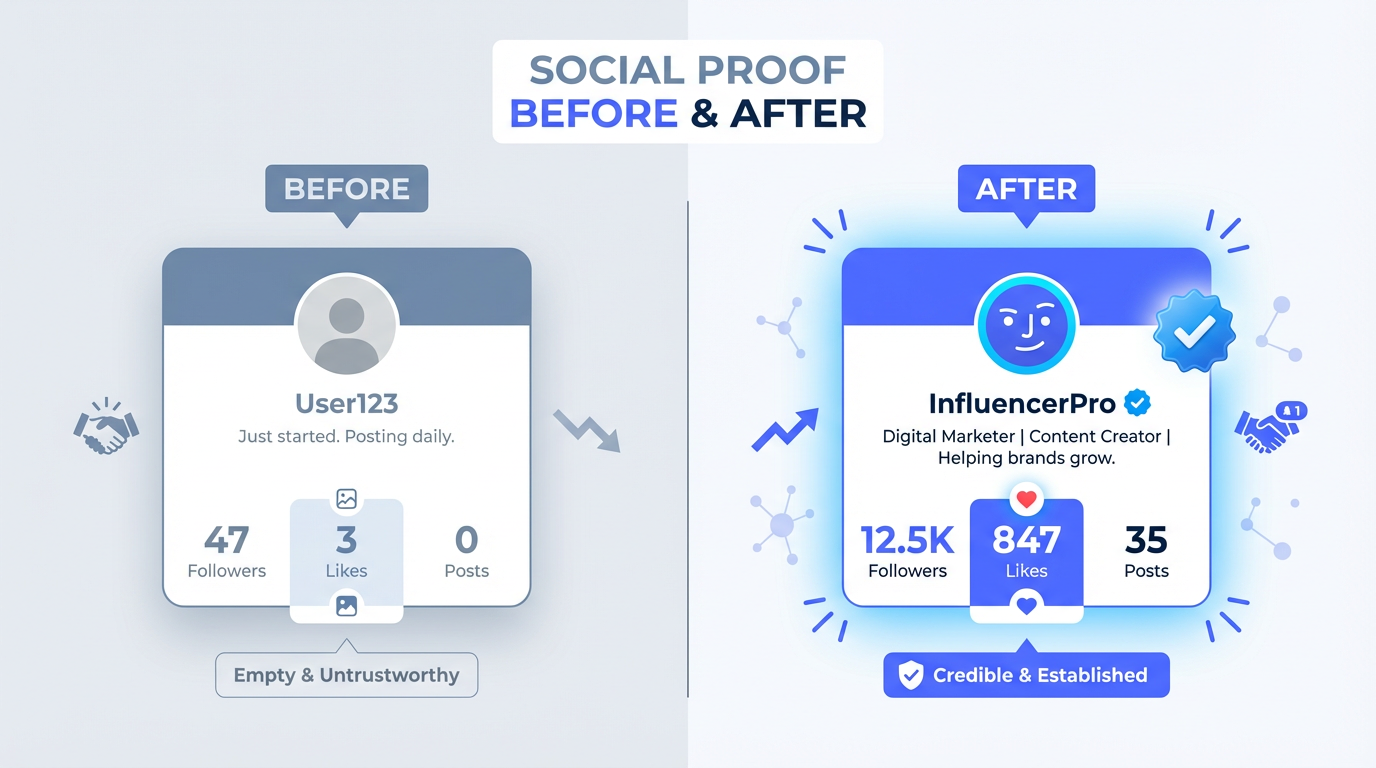
The absence of social proof is itself a signal — a negative one. An empty restaurant looks like it serves bad food. A product with zero reviews feels risky. A social media account with 47 followers and 2 likes per post looks… unreliable.
This isn’t fair, and it isn’t always accurate. A brand-new account might have exceptional content but zero traction. A new product might be genuinely excellent but lack reviews. But humans don’t make rational assessments — they make fast, heuristic-driven decisions. And the heuristic says: no social proof = not trustworthy.
The practical implications are significant:
- Lower conversion rates: Landing pages without social proof elements convert at 30-50% lower rates than those with testimonials, reviews, and social metrics.
- Reduced organic growth: The algorithmic feedback loop requires initial engagement to start. Without social proof attracting early engagement, your content gets less distribution.
- Higher customer acquisition costs: When trust is low, you need more touchpoints (and more ad spend) to convert a prospect into a customer.
- Missed partnership opportunities: Brands and collaborators evaluate potential partners partly on social proof metrics. Low numbers can cost you deals.
The solution isn’t to fake it until you make it — it’s to strategically build genuine social proof from day one.
How Do You Build Social Proof for a New Brand?
Building social proof from zero requires a multi-pronged approach:
Phase 1: Foundation (Week 1-4)
- Optimize your profiles with professional branding, clear bios, and consistent visual identity
- Establish initial credibility by boosting your key metrics. Use engagement services to build a baseline follower count and engagement level that signals legitimacy to new visitors
- Collect and display 5-10 genuine testimonials or reviews from early customers, friends, or beta users
- Post 15-20 pieces of high-quality content to fill your profile grid
Phase 2: Momentum (Month 2-3)
- Implement a user-generated content strategy — encourage customers to share their experiences with a branded hashtag
- Collaborate with 3-5 micro-influencers in your niche for expert and celebrity social proof
- Continue building engagement metrics on your best-performing content to maintain the growth flywheel
- Apply for relevant certifications, badges, and verification
Phase 3: Compound Growth (Month 4+)
- Your social proof flywheel should be generating organic momentum at this point
- Focus on amplifying your top-performing content to maximize the compound effect
- Diversify social proof types — combine user reviews, engagement metrics, press mentions, and expert endorsements
- Scale your presence across multiple platforms to create cross-platform social proof
For a complete step-by-step guide on building your brand from zero, check out our resource on how to grow your brand on social media from scratch.
How Do Social Media Metrics Function as Social Proof?
Let’s get specific about how each metric serves as social proof:
Follower count: The most visible social proof signal. It’s the first number most visitors see. Crossing key thresholds (1K, 10K, 100K) creates significant perception shifts. Accounts that cross 1,000 followers see a measurable increase in organic follow rate.
Likes: Signal content quality. A post with 500 likes tells new visitors “other people found this valuable.” Likes are especially important for first impressions — they’re the most visible engagement metric on most platforms.
Comments: Signal community engagement. Comments indicate that people aren’t just passively liking but actively discussing. High comment counts suggest a vibrant, engaged community — which is attractive to potential followers.
Views: Signal reach and relevance. High view counts on videos suggest content worth watching. On platforms like TikTok and YouTube, view counts are the primary social proof metric.
Shares/Reposts: The strongest social proof signal. When someone shares your content, they’re putting their own reputation behind it. High share counts indicate content so good that people want to associate with it.
Saves: A hidden but powerful signal. Saves indicate content worth revisiting — a strong quality indicator that both algorithms and observant visitors notice.
Each of these metrics contributes to the overall social proof picture. They work together — a post with 1,000 likes but 0 comments looks different from one with 500 likes and 200 comments. The latter suggests deeper engagement and a more authentic community.
How SMP Can Help
SMP is built around the understanding that social proof isn’t vanity — it’s infrastructure. Your engagement metrics are the foundation upon which organic growth is built.
Here’s how SMP helps you build social proof strategically:
- Followers across 10+ platforms: Build the baseline follower count that signals credibility on Instagram, TikTok, YouTube, Facebook, Twitter/X, and more.
- Engagement metrics: Boost likes, views, comments, and shares on your best content to create the engagement signals that attract organic interaction.
- Kickstart the flywheel: SMP solves the cold-start problem. Instead of waiting months to accumulate enough social proof for the flywheel to spin, you accelerate the process and let organic growth take over sooner.
- Affordable and scalable: Start small — even a modest investment in social proof can produce outsized returns once the compound effect kicks in.
Social proof begets social proof. SMP gives you the initial push that makes organic growth possible.
Key Takeaways
- Social proof is a psychological principle where people look to others’ actions to guide their own decisions. It’s the single most influential factor in online trust.
- There are 6 types of social proof: expert, celebrity, user, wisdom of the crowd, wisdom of friends, and certification. The strongest brands leverage multiple types simultaneously.
- On social media, your metrics (followers, likes, views, comments) are your social proof. Visitors evaluate your credibility in under 4 seconds based primarily on these numbers.
- Social proof creates a growth flywheel: initial proof attracts organic proof, which attracts more organic proof. The compound effect is powerful.
- The absence of social proof is a negative signal. Accounts and brands with low metrics face higher acquisition costs and lower conversion rates.
- 92% of consumers trust recommendations from others over branded content. 87% read online reviews before making decisions. Social proof drives real purchasing behaviour.
- Building social proof is a 3-phase process: establish a foundation, build momentum, then let compound growth take over.
- Strategic investment in social proof — through content, testimonials, collaborations, and tools like SMP — is one of the highest-ROI growth strategies available.
- Social proof isn’t vanity. It’s the infrastructure that makes organic growth possible.