TL;DR: Every social media platform uses an algorithm that decides which content gets seen and which gets buried. The core mechanic is the same everywhere — early engagement signals determine reach potential. Understanding how these systems work gives you a massive advantage, because you can design your content and posting strategy to trigger the exact signals algorithms reward.
You’ve probably experienced it. You post something you’re genuinely proud of, and it gets 23 views. Then you post a random throwaway thought, and it reaches thousands. It feels random, but it isn’t. Every view, every impression, every piece of content that appears in a feed is there because an algorithm put it there.
Understanding these algorithms isn’t optional anymore. It’s the difference between growing and shouting into the void.
What Exactly Is a Social Media Algorithm?
A social media algorithm is a set of rules and machine learning models that determine what content to show each user, in what order, and how often. No human is curating your feed — it’s a system processing billions of data points in real time.
The core job of every algorithm is the same: keep users on the platform as long as possible. Content that achieves this goal gets rewarded with distribution. Content that doesn’t gets suppressed.
Every major platform’s algorithm evaluates content on three dimensions:
- Relevance: How likely is this user to be interested in this content, based on their past behaviour?
- Quality: Is this content engaging, original, and well-produced based on aggregate user signals?
- Timeliness: How fresh is this content relative to other competing content?
The weighting of these dimensions varies by platform, but the principle is universal. Let’s break down each major platform.
How Does the Instagram Algorithm Work?
Instagram doesn’t have one algorithm — it has multiple systems that power different surfaces (Feed, Reels, Stories, Explore). Each works slightly differently, but they share common signals.
Feed and Stories algorithm signals (ranked by importance):
- Relationship: How often do you interact with this account? If you regularly like, comment, DM, or view someone’s Stories, Instagram shows you more of their content. Accounts you’ve never interacted with are deprioritised.
- Interest: Instagram predicts how likely you are to engage with a post based on your past behaviour. If you consistently engage with fitness content, fitness posts rank higher in your feed.
- Timeliness: Newer posts rank higher. Instagram’s feed isn’t purely chronological, but recency is a significant factor. A post from 2 hours ago will generally outrank one from 2 days ago.
- Engagement velocity: This is the critical one. Posts that receive high engagement (likes, comments, saves, shares) within the first 30-60 minutes after posting get dramatically more distribution. Instagram interprets rapid engagement as a quality signal and pushes the content to Explore and to non-followers.
Reels algorithm signals:
Instagram Reels uses a different recommendation system focused on entertainment value for non-followers:
- Watch time and completion rate: The single most important metric. A Reel that 80% of viewers watch to completion will massively outperform one where most viewers swipe away in the first 3 seconds.
- Engagement actions: Likes, comments, shares, and especially saves. Saves are weighted heavily because they indicate content worth revisiting.
- Audio usage: Reels using trending audio get a distribution boost. Instagram actively promotes content using sounds it’s trying to make viral.
- Originality: Instagram’s algorithm penalises content it detects as recycled from other platforms (yes, it can detect TikTok watermarks). Original content gets priority.
The practical takeaway: for Instagram growth, your first 60 minutes after posting determine everything. This is why many creators and businesses use Instagram engagement services — that initial engagement burst is the trigger for algorithmic distribution.
How Does the TikTok Algorithm Work?
TikTok’s algorithm is widely considered the most sophisticated and the most democratic. Unlike Instagram, where your existing audience heavily influences reach, TikTok evaluates every video independently. A brand-new account can go viral on its first post.
TikTok’s recommendation system works in tiers:
Tier 1 — Initial test (100-500 views): Every video is shown to a small, random sample of users. TikTok measures how this group responds.
Tier 2 — Expanded distribution (1,000-10,000 views): If the Tier 1 audience responds positively, TikTok pushes the video to a larger group of users with similar interests.
Tier 3 — Viral potential (10,000-1,000,000+ views): Content that continues performing well gets pushed to increasingly large audiences, potentially reaching the main For You Page.
The signals TikTok weighs most heavily:
- Completion rate (most important): What percentage of viewers watched the entire video? Videos with high completion rates are treated as high-quality content. This is why shorter videos (15-30 seconds) often outperform longer ones — they’re easier to complete.
- Rewatch rate: Did viewers watch it more than once? Rewatches are an extremely strong signal. Content that’s rewatchable (plot twists, satisfying visuals, complex information) gets massive boosts.
- Shares: TikTok weights shares higher than likes. A share indicates content worth passing to friends — the strongest endorsement possible.
- Comments: Both volume and depth. Comments that generate conversation (replies, debates) signal engagement quality.
- Profile visits after watching: If a viewer watches your video and then visits your profile, TikTok interprets this as strong interest and boosts the video further.
The critical insight is that TikTok’s Tier 1 test determines everything. If your video underperforms in that initial 100-500 view window, it dies regardless of how good the content is. This is the exact reason creators use TikTok engagement services — to ensure the Tier 1 test goes well, unlocking Tier 2 and Tier 3 distribution.
How Does the YouTube Algorithm Work?
YouTube’s algorithm is the most complex and the most well-documented. YouTube has been more transparent about its recommendation system than any other platform, partly because creator success directly impacts YouTube’s ad revenue.
YouTube uses two primary systems:
Search algorithm: Ranks videos for specific search queries. Optimised by keyword-relevant titles, descriptions, tags, and transcripts. YouTube’s search algorithm has evolved to prioritise watch time over keyword matching — a video with fewer keywords but higher retention will outrank a keyword-stuffed video with poor retention.
Recommendation algorithm (suggested videos, home feed): This drives 70%+ of all YouTube views. It evaluates:
- Click-through rate (CTR): What percentage of people shown your thumbnail actually click? YouTube considers 4-6% average, 6-10% good, and 10%+ exceptional. Your thumbnail and title are arguably more important than the video content for initial distribution.
- Average view duration (AVD): How long do viewers watch before leaving? YouTube wants viewers on the platform, so videos that retain attention get promoted. A 10-minute video with 60% AVD (6 minutes watched) outperforms a 20-minute video with 20% AVD (4 minutes watched).
- Session duration: Does your video lead to more YouTube watching? Videos that lead viewers to watch more YouTube content (even from other creators) get algorithmically rewarded.
- Subscriber engagement: When you publish a new video, how quickly do your subscribers watch it? High early-subscriber engagement signals that your audience values your content. This is why a strong subscriber base matters — YouTube subscriber services help build the foundation that generates these early signals.
- Engagement signals: Likes, comments, and shares all factor in, but they’re secondary to CTR and AVD.
YouTube Shorts algorithm: Functions similarly to TikTok. Completion rate is king, and the algorithm tests Shorts with small audiences before expanding distribution. Shorts are now YouTube’s primary discovery mechanism for new channels.
How Does the Facebook Algorithm Work?
Facebook’s algorithm has shifted dramatically toward Reels and Group content. The traditional feed of friend updates has been partially replaced by an AI-curated discovery feed similar to TikTok’s For You Page.
Key Facebook algorithm signals:
- Meaningful interactions: Facebook prioritises content that generates comments and shares over passive likes. A post with 50 comments outranks one with 500 likes in most cases.
- Content type preference: The algorithm learns each user’s preferred content type (video, photos, links, text) and shows more of what they engage with. For creators, this means knowing your audience’s format preference matters.
- Relationship strength: Similar to Instagram, Facebook heavily weights existing relationships. Content from accounts a user regularly interacts with gets priority.
- Group engagement: Facebook Groups content receives preferential treatment in the feed. Active groups with high engagement ratios see their posts distributed more broadly.
- Reels distribution: Facebook is aggressively pushing Reels. Short-form video content receives 2-3x the organic distribution of other post types. Facebook engagement services can amplify this advantage.
What Is the Engagement-Reach Feedback Loop?
This is the most important concept in algorithmic social media growth, and understanding it changes how you approach every platform.
The feedback loop works like this:
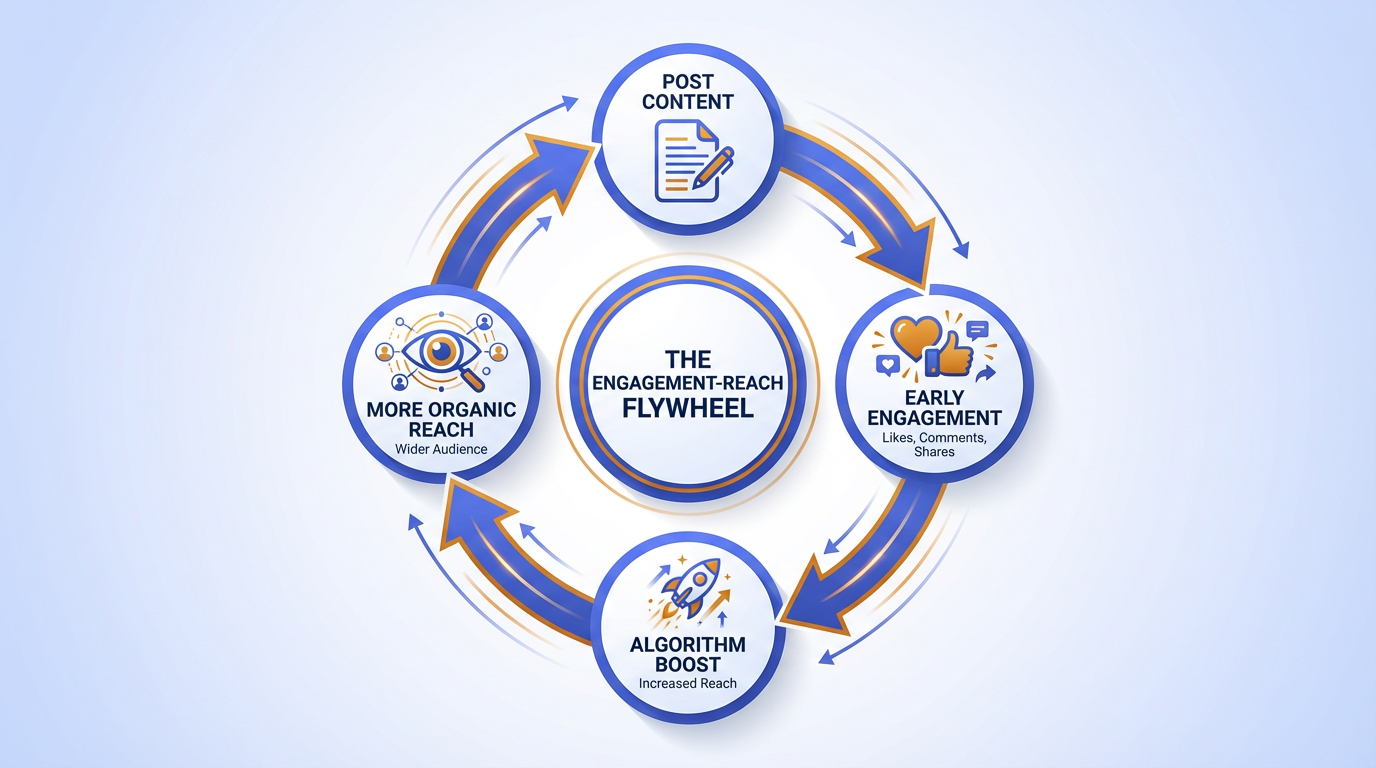
Early engagement → Algorithm detects quality → Expanded distribution → More organic views → More organic engagement → Further distribution → Viral potential
This loop exists on every platform. The variable is the trigger — the initial engagement that starts the cycle. On TikTok, it’s the Tier 1 test. On Instagram, it’s the first 30-60 minutes. On YouTube, it’s the first 24-48 hours of subscriber engagement and CTR.
Here’s the brutal truth: amazing content with zero initial engagement gets zero distribution. The algorithm never discovers it. Meanwhile, good content (not great, just good) with strong initial engagement can reach millions.
This is why strategic engagement boosting isn’t a shortcut — it’s a distribution strategy. It provides the initial signal that starts the feedback loop. From there, the content needs to deliver genuine value to sustain organic growth. The boost opens the door; the content has to walk through it.
Research from social media analytics firm Socialinsider found that posts receiving 50+ engagements within the first hour see an average of 3.2x more total reach than posts that accumulate the same engagement over 24 hours. Velocity matters more than volume.
What Signals Hurt Your Algorithmic Reach?
Just as certain signals boost your content, others actively suppress it:
- Low engagement rate relative to followers: If you have 10,000 followers but your posts get 30 likes, the algorithm interprets this as your audience not caring about your content. It reduces your reach further, creating a negative spiral.
- High bounce rate: Viewers clicking on your content and immediately leaving signals low quality. On YouTube, this is measured as low AVD. On TikTok and Reels, it’s a low completion rate.
- Content removal or reports: If your content is frequently reported or removed, the algorithm reduces your overall account’s distribution.
- Inconsistency: Algorithms favour accounts that post regularly. Long gaps between posts reduce your algorithmic standing, and it takes consistent posting to rebuild momentum.
- Cross-platform watermarks: Instagram penalises Reels with TikTok watermarks. TikTok penalises content obviously recycled from Instagram. Create natively for each platform.
How Do You Work With the Algorithm Instead of Against It?
The difference between creators who grow and those who stagnate isn’t talent — it’s algorithmic literacy. Here’s the actionable framework:
- Post when your audience is online: Check your platform analytics for peak activity times. Posting when your audience is active gives you the best shot at rapid early engagement.
- Design for the first 3 seconds: Whether it’s a video hook, a carousel cover slide, or a tweet’s opening line — the first impression determines whether someone engages or scrolls past.
- Encourage active engagement: Ask questions. Create debates. Use polls. Comments and shares are weighted far higher than likes on every platform.
- Use platform-native features: Every platform rewards usage of its newest features. When Instagram launches a new sticker, use it. When YouTube introduces a new Shorts feature, adopt it early.
- Boost your best content: Identify your top-performing content and give it an engagement boost to trigger the feedback loop. This is where tools like SMP become strategic — not every post needs boosting, but your best 20% of content absolutely should get that initial push.
- Maintain a healthy engagement ratio: Don’t chase follower counts without maintaining engagement. A 3-5% engagement rate is the healthy range. If your ratio drops, focus on engagement quality before growing your audience further.
For a comprehensive look at the benefits of strategic boosting, read our deep-dive on the 10 proven benefits of boosting social media posts.
How SMP Can Help
Understanding algorithms is step one. Acting on that understanding is step two. SMP bridges the gap between great content and algorithmic discovery.
SMP provides the early engagement signals — likes, views, subscribers, and more — that trigger algorithmic distribution across every major platform. Instead of hoping the algorithm picks up your content organically, you give it the engagement velocity it needs to enter the feedback loop.
This isn’t about faking popularity. It’s about solving the cold-start problem that kills most good content before anyone sees it. Your content does the rest.
SMP supports 10+ platforms, delivers within minutes, and starts at prices that make traditional social media ads look absurdly expensive by comparison. If you understand how algorithms work, you understand why a tool like SMP exists.
Key Takeaways
- Every platform’s algorithm prioritises content that receives strong early engagement — this is the single most important growth lever.
- Instagram’s algorithm weighs relationship signals, engagement velocity (first 30-60 minutes), and content format diversity.
- TikTok’s tier-based testing system means the first 100-500 views determine your video’s entire reach potential.
- YouTube prioritises click-through rate and average view duration above all other signals. Your thumbnail and retention strategy matter most.
- Facebook has shifted toward Reels and meaningful interactions (comments and shares over likes).
- The engagement-reach feedback loop is universal: early engagement triggers algorithmic distribution, which drives organic engagement, which triggers more distribution.
- Posts that receive 50+ engagements in the first hour see 3.2x more total reach on average.
- Low engagement rates, inconsistency, and cross-platform watermarks actively hurt your algorithmic standing.
- Strategic engagement boosting solves the cold-start problem by providing the initial signals algorithms look for.
- Combine algorithmic understanding with tools like SMP to ensure your best content gets the distribution it deserves.