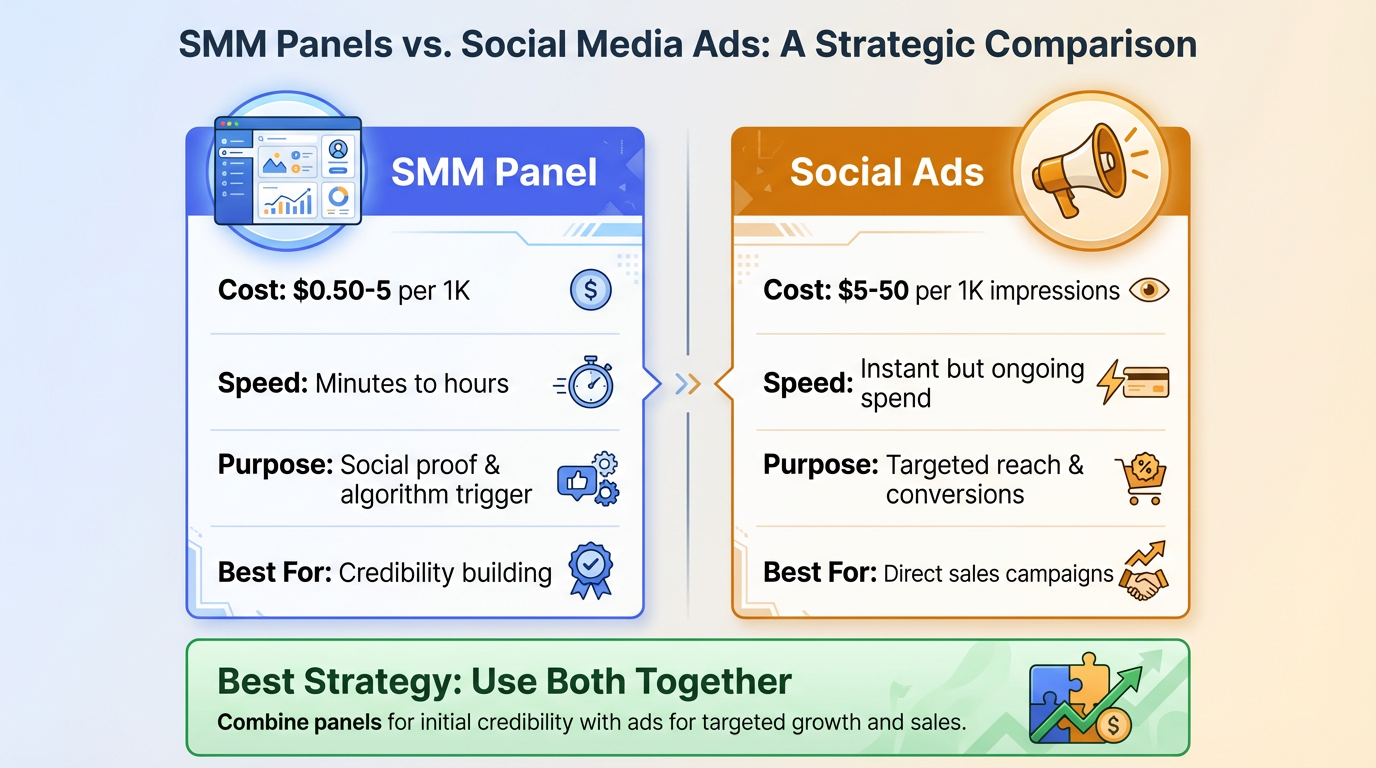
TL;DR: SMM panels and social media ads serve fundamentally different purposes. Panels are 10-100x cheaper per engagement unit and excel at building social proof and baseline credibility. Ads excel at targeting specific demographics and driving direct conversions. The smartest strategy uses both — panels to build your foundation, ads to drive targeted results on top of it.
Every marketer with a limited budget faces this decision: do I spend on social media ads, or do I invest in an SMM panel to build my numbers? The honest answer is that framing it as an either/or choice is the wrong approach. These are complementary tools that serve different purposes. But understanding the trade-offs is essential to allocating your budget wisely.
This guide breaks down both strategies across every dimension that matters — cost, speed, targeting, long-term value, and ROI — with specific numbers so you can make informed decisions.
What’s the Core Difference?
Before comparing specifics, let’s clarify what each tool actually does:
SMM panels deliver engagement metrics — followers, likes, views, comments, subscribers — directly to your profiles and content. You’re buying social signals. The value is social proof (looking credible and established), algorithmic advantages (platforms promote content with engagement), and momentum (breaking through the cold-start problem).
Social media ads deliver targeted exposure — impressions, clicks, and conversions — to specific audiences. You’re buying attention from people who match your target demographics. The value is direct: traffic to your website, app installs, product sales, lead generation, or brand awareness among a defined audience.
Same budget. Very different outcomes. Let’s compare.
How Do the Costs Compare?
This is where the difference is most dramatic.
SMM Panel Costs (per 1,000 units)
| Service | Typical Cost |
|---|---|
| Instagram Followers | $0.60-1.50 |
| Instagram Likes | $0.20-0.80 |
| TikTok Views | $0.05-0.30 |
| YouTube Views | $1.00-3.00 |
| YouTube Subscribers | $3.00-6.00 |
| Facebook Page Likes | $1.00-3.00 |
| Twitter/X Followers | $0.80-2.00 |
Social Media Ad Costs (per 1,000 impressions / CPM)
| Platform | Average CPM (2026) |
|---|---|
| $6.00-14.00 | |
| TikTok | $4.00-10.00 |
| YouTube | $8.00-20.00 |
| $5.00-12.00 | |
| Twitter/X | $3.00-8.00 |
| $15.00-45.00 |
Note: CPM is cost per 1,000 impressions (views of your ad), not cost per 1,000 engagements. The cost per actual engagement (click, like, follow) from ads is dramatically higher.
The Real Comparison: Cost Per Follower
Let’s normalize to a common goal — gaining 1,000 Instagram followers:
Via SMM panel (SMP): $0.60-1.50 total. Order placed, delivered within hours to days.
Via Instagram ads: At an average cost-per-follower of $2-5 (industry average for follower campaigns), that’s $2,000-5,000 for 1,000 followers. And that’s optimistic — many businesses report cost-per-follower above $5.
The math is unambiguous: for the specific goal of increasing follower counts, SMM panels are roughly 1,000-3,000x more cost-effective than paid ads.
But — and this is a critical “but” — those numbers only tell part of the story. A follower gained through an ad is someone who saw your content, found it relevant to their interests, and chose to follow you. They’re pre-qualified. A follower from an SMM panel is a number on your profile that contributes to social proof but doesn’t represent a potential customer. Different value. Different purpose.
How Does Speed Compare?
SMM Panels
Speed is a core advantage of panels. Place an order and see results in minutes to hours:
- Followers: 2-24 hours for most orders (with drip-feed over 1-7 days for safety)
- Likes: 5 minutes to 2 hours
- Views: Nearly instant to 6 hours
- Subscribers: 4-48 hours depending on platform
You can go from 0 to 10,000 followers in a week without breaking a sweat. That kind of velocity is impossible through ads at any budget.
Social Media Ads
Ad campaigns require setup time — creative production, audience targeting, A/B testing, and optimization. A well-run campaign takes 1-2 weeks to stabilize and start delivering consistent results. The learning phase alone (where the platform’s algorithm optimizes your delivery) typically lasts 3-7 days.
For follower growth specifically, ads are slow. Most ad formats are optimized for clicks and conversions, not follows. Running a “follower campaign” on Instagram means paying a premium for an objective the platform doesn’t optimize well.
Winner for speed: SMM panels, decisively.
What About Targeting and Audience Quality?
This is where ads have an undeniable advantage.
SMM Panel Targeting
Panels offer limited targeting. You might be able to specify a country or region for followers, or choose between “worldwide” and “targeted” services. But you can’t target by:
- Age, gender, or income level
- Interests or behaviors
- Job title or industry
- Purchase intent
- Custom audiences (email lists, website visitors)
The followers you get from a panel are social proof, not a targeted audience segment.
Social Media Ad Targeting
Ad platforms offer granular targeting that can reach exactly the people most likely to become customers:
- Demographics: age, gender, location, language, education, income
- Interests: hobbies, brands they follow, content they engage with
- Behaviors: purchase history, device usage, travel patterns
- Custom audiences: your existing customers, email subscribers, website visitors
- Lookalike audiences: people similar to your best customers
This targeting is the core value of paid advertising. When you need to reach women aged 25-34 in Harare who are interested in skincare and have made online purchases in the last 30 days, no SMM panel can do that. Only ads can.
Winner for targeting: Social media ads, decisively.
Which Delivers Better Long-Term Value?
This depends entirely on your definition of “value.”
SMM Panel Long-Term Value
Panel services deliver lasting social proof. Once you have 50,000 Instagram followers, that number persists (with minor attrition, covered by refill guarantees). Visitors to your profile see established credibility from day one.
The compounding effect is real: higher follower counts lead to higher organic reach, which leads to more real followers, which leads to even more reach. Research suggests that accounts crossing certain thresholds (1K, 10K, 100K followers) experience measurably higher organic engagement rates, partially because the algorithm favors established accounts and partially because humans are drawn to social proof.
However, panel services don’t build customer relationships, generate sales directly, or create a qualified audience for remarketing.
Social Media Ad Long-Term Value
Ads generate immediate, measurable business outcomes — website visits, email signups, product purchases, app installs. Each conversion represents a real person who took a real action because they were interested in what you offer.
The long-term value comes from the customer relationships these conversions create. An email subscriber gained through ads can be nurtured over months into a loyal customer worth hundreds or thousands of dollars. An SMM panel follower cannot.
But ads stop the moment you stop paying. There’s no lasting equity in ad spend the way there is in follower counts. Turn off ads and traffic goes to zero. Stop ordering panel services and your followers remain.
Verdict: Neither wins outright. Panels build lasting social assets. Ads build customer relationships.
How Does Each Affect the Algorithm?
Both strategies influence platform algorithms, but through different mechanisms.
SMM Panels and Algorithms
Engagement signals are a primary input to social media algorithms. When your post receives likes, views, comments, and shares shortly after publishing, algorithms interpret this as a signal of quality content and distribute it more widely.
Buying engagement on your content can trigger this organic amplification cycle. A TikTok video with 5,000 purchased views in the first hour has a significantly higher chance of being pushed to the For You page than one with 50 organic views. Similarly, an Instagram Reel with 500 purchased likes may get picked up by the Explore page algorithm.
This “engagement snowball” effect is arguably the highest-value use case for SMM panels. You’re not just buying views — you’re buying the algorithmic trigger that produces thousands of organic views on top.
Social Media Ads and Algorithms
Ads operate outside the organic algorithm. Your ad reaches people because you paid for placement, not because the algorithm selected it. However, ads can indirectly boost organic reach:
- If people who see your ad visit your profile and follow you, your organic content benefits from a larger audience.
- High-performing ads with strong engagement can generate social proof that influences organic viewers.
- Retargeting campaigns can re-engage people who discovered you organically.
The key difference: panel services directly feed the organic algorithm. Ads bypass it. Both can result in organic growth, but through fundamentally different paths.
When Should You Use SMM Panels?
Panels are the better investment when your goal is:
-
Building social proof from zero. A new brand page with 47 followers faces an uphill battle. Reaching a credible baseline (5,000-10,000 followers) through panels costs $5-15 and transforms how visitors perceive your brand.
-
Amplifying specific content. You published a post you believe in. Boosting its engagement through likes and views can trigger algorithmic distribution that produces organic virality. This costs a fraction of promoting the same post through ads.
-
Maintaining consistent metrics. Agencies managing client accounts need to show steady growth. Panel services deliver predictable, consistent numbers that keep clients satisfied while organic strategies build long-term value.
-
Competing in engagement-driven spaces. Music, entertainment, and content creation are industries where raw numbers open doors. Spotify plays, YouTube views, and TikTok engagement directly impact playlist placements, sponsorship opportunities, and monetization eligibility.
-
Lowering ad costs. Accounts with strong social proof see lower cost-per-click on their ads. Building a follower base through panels before running ad campaigns can reduce your overall marketing costs.
When Should You Use Ads?
Ads are the better investment when your goal is:
-
Direct conversions. Website sales, app installs, lead generation — any goal that requires a specific action from a targeted person.
-
Reaching a defined audience. If you know exactly who your customer is (demographics, interests, behaviors), ads let you reach them directly.
-
Retargeting. Re-engaging people who visited your website, viewed a product, or abandoned a cart. No panel offers this capability.
-
Testing messaging and creative. Ad platforms provide A/B testing infrastructure that tells you which messaging resonates with your audience. This data is valuable beyond the campaigns themselves.
-
Scaling revenue. Once you’ve found an ad formula that works (positive ROAS), you can scale by increasing spend. The relationship between spend and revenue is direct and measurable.
What’s the Optimal Combined Strategy?
The smartest marketers use both. Here’s a practical framework:
Phase 1: Foundation (Month 1)
- Use an SMM panel to build a credible baseline: 5,000-10,000 followers on your primary platform
- Purchase engagement (likes, views) on your best 5-10 posts to create a polished, active-looking profile
- Budget: $20-50 through SMP
Phase 2: Content + Amplification (Months 2-3)
- Publish consistent, quality content (3-5x per week)
- Use panel services to boost each post’s engagement in the first 1-2 hours after publishing
- Let algorithmic amplification drive organic growth
- Budget: $30-60/month through SMP
Phase 3: Ads on a Strong Foundation (Month 4+)
- Launch targeted ad campaigns from an account with social proof
- Your established follower count and engagement metrics lower ad costs
- Visitors who see your ads check your profile — strong numbers increase conversion rates
- Budget: Allocate 70% to ads, 30% to panel maintenance
This combined approach typically outperforms either strategy in isolation because each tool amplifies the other. Panel-built social proof makes ads more effective. Ad-driven real engagement makes panel-built numbers more convincing.
How Do ROI Metrics Compare?
| Metric | SMM Panels | Social Media Ads |
|---|---|---|
| Cost per follower | $0.001-0.005 | $2-5+ |
| Cost per 1K views | $0.05-3.00 | $5-20+ (CPM) |
| Time to results | Minutes to hours | Days to weeks |
| Targeting precision | Low | High |
| Direct conversions | None | High |
| Social proof value | High | Low-Medium |
| Algorithm impact | Direct | Indirect |
| Lasting equity | High (followers persist) | Low (stops with spend) |
| Scalability | High | High |
For a deeper understanding of how to measure ROI from social media engagement, see our guide on the ROI of social media engagement.
How SMP Can Help
SMP makes the panel side of your combined strategy effortless. Whether you’re in the foundation phase building initial credibility or in maintenance mode boosting content alongside ad campaigns, the platform offers:
- 10+ platforms in a single dashboard — no need to juggle multiple panels for different platforms
- Content amplification services — likes, views, comments, and saves on Instagram, TikTok, YouTube, and more
- Drip-feed delivery to keep growth patterns natural alongside your organic and ad-driven activity
- Competitive pricing that maximizes what you get from the panel portion of your budget
- African payment methods — EcoCash, OneMoney, and mobile money alongside cards and crypto
The goal isn’t to replace your ad budget with panel services. It’s to make every dollar of your ad budget work harder by building the social proof foundation that lowers costs and increases conversions.
Start building your foundation at smp.co.zw.
For more context on what SMM panels are and how to evaluate them, explore our guides.
Key Takeaways
- SMM panels and social media ads serve different purposes. Panels build social proof and algorithmic momentum. Ads drive targeted traffic and direct conversions.
- For pure engagement metrics (followers, likes, views), panels are 10-100x more cost-effective than ads.
- Ads offer unmatched targeting — demographics, interests, behaviors, custom audiences — that panels cannot replicate.
- The optimal strategy combines both: use panels to build a credible foundation, then run ads from an account with established social proof.
- Accounts with strong engagement see lower cost-per-click on ads, meaning panel investment can reduce your overall ad costs.
- Phase your approach: foundation (panels) → content amplification (panels + organic) → targeted campaigns (ads + panel maintenance).
- SMP offers the platform coverage, pricing, and delivery options to power the panel side of a combined growth strategy. Get started today.